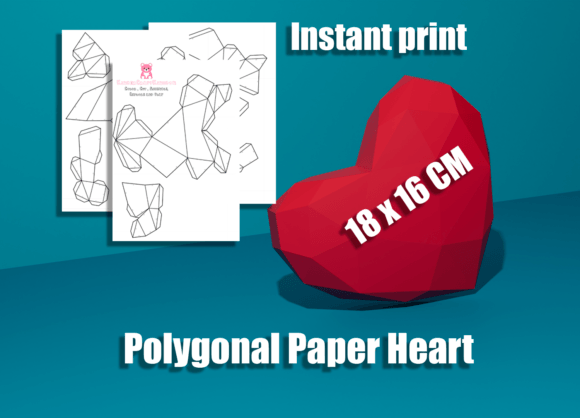
Polygonal Heart 3D Papercraft
In an era where digital saturation often drowns out meaningful connection, the value of tangible, handcrafted experiences has surged. For professionals, creators, and decision-makers seeking to differentiate their brand or personal touch, Polygonal Heart 3D Papercraft represents more than a simple hobby; it is a strategic tool for engagement, mindfulness, and precise communication. This low-poly paper sculpture offers a unique intersection of geometric design and emotional resonance, providing a physical artifact that stands out in both personal and professional contexts.
The concept behind this model is rooted in the aesthetic of low-polygon graphics—a style that reduces complex shapes into their fundamental geometric components. When translated into three dimensions, these facets create a striking visual interplay of light and shadow. Unlike mass-produced gifts or generic digital assets, a self-assembled Polygonal Heart 3D Papercraft embodies effort, intention, and creativity. It serves as a testament to the maker’s attention to detail, making it an ideal medium for educators teaching geometry, entrepreneurs showcasing bespoke branding, or individuals looking to express sentiment through a structured, artistic lens.
Strategic Applications Beyond Decoration
While the primary appeal of the Polygonal Heart 3D Papercraft lies in its Valentine’s Day relevance, its utility extends far beyond holiday gifting. For marketers and content creators, this object can serve as a prop in photography, a centerpiece in experiential marketing, or a tangible reward in customer loyalty programs. The geometric nature of the heart appeals to modern design sensibilities, bridging the gap between traditional romance and contemporary minimalism.
For educators and trainers, assembling this model provides a practical lesson in spatial reasoning, precision, and patience. It transforms abstract concepts of geometry into a concrete reality. Similarly, for freelancers and designers, the process of constructing the model can act as a mental reset, offering a break from screen-based work while engaging fine motor skills and cognitive focus. The deliberate, step-by-step nature of the assembly encourages a state of flow, reducing stress and enhancing productivity by allowing the mind to rest from high-level strategic thinking.
Furthermore, small business owners can leverage the aesthetics of low-poly designs in their packaging or store displays. The clean lines and faceted surfaces of the Polygonal Heart 3D Papercraft reflect a modern, tech-forward brand identity. By incorporating such elements into their physical environment, businesses can communicate sophistication and care, subtly influencing customer perception and fostering a deeper emotional connection with their audience.
Technical Specifications and Material Requirements
To achieve a result that reflects quality and professionalism, selecting the right materials is critical. The Polygonal Heart 3D Papercraft is designed as a comprehensive digital template available for instant download in PDF format. However, the final outcome is heavily dependent on the substrate used. Standard printer paper lacks the structural integrity required for a stable 3D form. Instead, users should utilize colored cardstock or thin cardboard with a weight between 200g-300g (90lb-110lb). This thickness ensures that the folds hold their shape without collapsing under the weight of adjacent panels.
- Printer: A standard inkjet or laser printer is sufficient for reproducing the template. Ensure the print quality is sharp to facilitate accurate cutting along the guide lines.
- Substrate: Colored cardstock or thin cardboard (200g-300g / 90lb-110lb). White cardstock allows for custom coloring, while pre-colored options save time but limit customization.
- Cutting Tools: Sharp scissors for general cuts and a craft knife paired with a metal ruler and cutting mat for precise edges. Precision here is vital for seamless assembly.
- Adhesive: Paper glue (PVA) is recommended over spray adhesives or hot glue for better control and cleaner joints. Hot glue can warp thin cardstock if not applied sparingly.
- Measuring Tools: A metal ruler and a cutting mat are essential for ensuring straight folds and accurate alignment of the 8 distinct pieces.
Assembly Process: A Methodical Approach
The construction of the Polygonal Heart 3D Papercraft is categorized as "Easy" in difficulty, yet it requires a methodical approach to ensure success. The template comprises 3 pages containing 8 individual pieces. With an estimated assembly time of approximately 45 minutes, this project is manageable within a busy schedule, provided one dedicates uninterrupted focus to the task.
- Print and Prepare: Begin by printing the PDF template on your chosen cardstock. Verify that the print scale is set to 100% (no scaling) to maintain the correct proportions. The intended dimensions are Height 160 mm, Width 180 mm, and Depth 50 mm. Deviating from these dimensions will result in misaligned tabs and gaps.
- Cut with Precision: Carefully cut out each of the 8 pieces. Using a craft knife for intricate internal cuts and scissors for outer boundaries will yield the cleanest edges. Rough cuts can compromise the fit of the folding tabs.
- Fold Accurately: Use a bone folder or the back of a knife blade to score the fold lines before bending the paper. This creates crisp, professional-looking creases that define the low-poly aesthetic. Fold inward and outward as indicated by the template markings.
- Assemble Systematically: Apply PVA glue to the designated tabs. Work piece by piece, allowing slight drying time between connections to ensure stability. Start with the central core structure and build outward. Patience during this stage prevents misalignment, which is difficult to correct once the glue sets.
This structured workflow mirrors best practices in project management: plan, execute, review, and refine. By treating the assembly as a discrete project with clear milestones, you enhance the likelihood of a successful outcome. The tactile feedback of folding and gluing also reinforces the cognitive benefits mentioned earlier, grounding the creator in the present moment.
Decision-Making and Risk Mitigation
While the Polygonal Heart 3D Papercraft is accessible, relying on it without clear intent can lead to suboptimal results. One common pitfall is rushing the assembly process. In haste, users may skip scoring fold lines or use insufficient adhesive, resulting in a fragile model that loses its shape. To mitigate this risk, allocate sufficient time and workspace. Ensure adequate lighting to distinguish between subtle line variations on the template.
Another consideration is the choice of color. While vibrant colors attract attention, they may not align with all brand identities or recipient preferences. Neutral tones like white, black, or pastels often convey elegance and versatility. Consider the context of use: a bold red heart may be appropriate for a romantic gesture, whereas a monochromatic silver or gold version might suit a corporate event or gallery display. Strategic selection of materials and colors enhances the overall impact of the final product.
Additionally, be mindful of environmental factors. Humidity can affect paper stiffness, and extreme temperatures may cause glue to dry too quickly or too slowly. Working in a climate-controlled environment ensures consistent performance of materials. For those using the model for educational purposes, prepare backup templates in case of user error, turning mistakes into learning opportunities rather than failures.
Long-Term Value and Creative Integration
The true value of the Polygonal Heart 3D Papercraft lies in its longevity and adaptability. Once assembled, the model becomes a durable decorative item that can be displayed for years. Its geometric simplicity means it fits seamlessly into various interior design styles, from industrial lofts to minimalist apartments. For collectors, it represents a blend of art and engineering, appealing to those who appreciate the beauty of mathematical forms.
In a broader sense, engaging with papercraft models fosters a mindset of creation over consumption. In a world dominated by disposable digital content, holding a physical object you built yourself provides a sense of accomplishment and ownership. This shift in perspective can influence how professionals approach their work, encouraging them to seek depth and durability in their projects rather than fleeting trends. Whether used as a gift, a teaching aid, or a personal memento, the Polygonal Heart 3D Papercraft invites us to slow down, think critically, and create with purpose.
By integrating such hands-on activities into our routines, we balance the demands of modern life with the human need for tactile expression. The process is not just about creating a heart; it is about crafting a moment of clarity, precision, and care. As you navigate your next creative endeavor, consider the power of low-poly design and the enduring appeal of handmade objects. They remind us that even in a digital age, the most impactful experiences are often those we build with our own hands.